29 November 2006

When in Rome...

This JOI blogpost about Rome's Jewish community and intermarriage brought up old memories. Some very good ones of our brief contact with Jewish Rome--the world's best gefilte fish (in sweet-and-sour-tomato sauce), as part of a Shabbat dinner cooked by a wonderful older woman who lived within walking distance of the pensione where we stayed; wonderful melodies at the synagogue we went to that Friday night (founded by Jews who came mostly from Tripoli); the beautiful main synagogue and its museum...and some not-so-good ones, which I was moved to comment on there & repeat here:

On a previous visit to Italy, however, we were turned away from synagogue in Milan: we were asked whether we were Jewish, and being the honest person that he is, he replied that his conversion would take place in 3 weeks but he was not yet a Jew. "Sorry," said the 2 men doing security detail. "since we don't know you two--we could let her in, but not you." (One might wonder: how does having my word that I'm a Jew, versus his that he's not yet but is becoming one, make me inherently more trustworthy: there's something of the "All Cretans are liars" paradox here...)

"Didn't we just read in last week's Torah reading, 'There shall be one law for you, both for the stranger and for the native citizen'?" They were unmoved, but I was beginning to cry. So we left, and rejoined the rest of my family sightseeing in Milan's cathedral on a Shabbat morning, instead of in synagogue.

Luckily, that was the only time in our visits to synagogues abroad (Israel, Greece, England) and in the U.S. as a mixed couple that we were not made welcome as a couple because one of us was not Jewish. But that one casual rejection cut deeply: I'm glad we didn't have to endure it in a place where we're looking for community, and I feel for those who do. And I thank all those in my Jewish community in Arlington, VA (at what is Congregation Etz Chayim) for looking at my non-Jewish father, Jewish mother, and us 3 kids and seeing a family who's part of their community--not an outsider, a transgressor, and 3 future "victims" of assimilation whose Judaism will never stick.

I'm not going anywhere. :)

But I'm also not going to reject or abandon the non-Jewish members of my family and my husband's family, or parts of our past experiences that have to do with non-Jewish religion, in order to be where I am or go where I'm headed.

01 November 2006

More on tallit, tefillin, etc...

[from a note to an interesting Yahoo Group just a few days ago:]

With an anecdote, and a promise to say more soon (I first wore a tallit & kippah at my youngest brother's bar mitzvah, Parshat Vayera in 1991, and am going to give a dvar torah for that parshah in 2 weeks that deals with women & time-bound mitzvot[TBM]/ritual garb).

I just came back from the USCJ Seaboard Region Biennial Convention--which was happenening at the same time as Youth Director/USY and Kadima (youth group) staff training, so all of us enjoyed spirited davening & Shabbat meals together. I was the youngest among the non-Youth Director types (I'm 32, the next-youngest was a 42-yr-old woman who's president of her congregation; one or 2 of the Youth Directors looked to be older than me), who generally ranged from mid-50s/60s up to near 90.

I noticed on Friday night that the convention women were ALMOST ALL wearing kippot (sometimes girly ones, wire with beads, etc--but definitely kippot, not doilies, and only a hat or 2 to be seen--one on the 90-year-old--sometimes for fashion & with some other kippah etc underneath), and none of the younger women (20s & 30s) except me were doing so. On Saturday morning a glorious array of beautiful tallitot were to be seen, not just on the women (though we have the best ones!) but also on the men--and not only were ALMOST ALL of the convention women (and our honored speaker/scholar-in-residence, Rabbi Naomi Levy) wearing tallitot, but I'd say the #s of non-tallit-wearers were almost equal among the men and the women: there were a few guys not wearing tallit (not their custom before marriage? left theirs at home & there weren't extras brought? don't always wear one & didn't feel strongly about it? I don't know!) and a few women not wearing tallit.

Among the youth director/advisor contingent, only 2 women were wearing tallit + kippah: one who looked to be in her mid-40s, and one younger woman (who had not been wearing a kippah Friday night); there were also a few guys in that contingent not wearing tallit, but the ratio was nowhere near the same. I was pretty fascinated by this difference between the age groups/contingents, and had some guesses about some reasons that might account for it...but I was interested in talking with the older women about why they wore tallit/kippah (and when/why they started) and to the younger women about why they didn't.

So, after having some nice conversations with the older women on the former point, I took the opportunity at a meal on Sunday to ask the regional youth director (who headed up that part of the program & had moderated a panel I was on that morning, and had led some of the davening on Shabbat) about what I'd noticed --

and she burst out: "You're the THIRD person who's asked me about it!!!! I don't wear a tallit & kippah & tefillin & I'm proud of it!!!!"

(later said it's not that she's proud of it or making a statement, it's just not the way she grew up & so she's not comfortable doing it, but she also thinks that for younger women who have always known it's an option it's not as big a deal as for these older women who are reclaiming something in Judaism that had always been denied them as forbidden to women)

But I just wanted to highlight the switcheroo there: she felt pressure because she was being asked by others "why aren't you doing these things?" (i.e., this is the norm for our crowd: involved egalitarian Conservative Jews who are women) rather than, as many of us have been asked in other contexts, "why are you doing these things?" (i.e., this is not the norm for involved/observant Jews who are women).

One person was asking her with a critical agenda, but I think others of us were just curious (though I would hope to persuade her to try wearing tallit--I'll certainly send her my dvar torah when it's done). But she got the message that the rest of us don't take it for granted that not being TBM-obligated is the norm (or that you can recognize yourself as TBM-obligated but particularly neglect the ones that have been or seemed traditionally male).

Similarly, when daveners (men or women, and it IS women as often as men!) choose to daven the amidah option without the matriarchs (since our siddur, the revised Sim Shalom ["Slim Shalom"], gives both options), I ask them why they don't. Their assumption often is that the default is without matriarchs--often, it has been for them, and so they're "not comfortable" or "haven't practiced" adding them (they don't usually have an ideological/halakhic reason, though they certainly could)--whereas in our community, it really is becoming (if it hasn't already become) the norm to include them, so that the dominant question becomes "why are you omitting the imahot?" (or, more neutrally "not using the names of the imahot":"not adding them" tips the rhetorical balance the other way) rather than "why am I including/adding them?"

Tefillin trials and triumphs

[written 10/15/06; another placeholder/catch-up entry]

I laid tefillin for the very first time today. M. and I got to services sometime in Birkhot HaShachar [the morning blessings--pretty early on but not the very first thing], and he took out his tefillin, and I took out "mine" (my brother's: he lives in Singapore, and the last time we were home in Louisville, where his tefillin have been languishing unused, I asked if I could take them to DC and borrow them for now--he said sure). I watched what he did, followed his lead on the shel yad [the one for the hand], listened for his whispered instructions when I wasn't sure; I discovered that my brother's tefillin shel rosh [the one that goes on your head] was way way way too big in circumference, and I didn't know how to make it tighter on the spot (didn't seem like a slip knot--needs un-and re-tying?), so I just settled for trying to tuck the back of it under my hair and keep the whole thing from slipping down onto the top of my glasses. I had just finished up the shel yad, got my nice letter-shin shape on the back of the hand, was figuring out how to tuck the last end bit under the wrapped sections on the palm side and feeling pretty pleased, looking forward to saying a shecheyanu for this new experience....

When A Man In A Position of Clerical Authority came up to burst my bubble. "You've got it on wrong. It's a slip knot--you need to go against the slip knot" (re: the shel yad, which I'd done as M. did it.) "And this is too loose" (re: the shel rosh; "I know," I said, "It's not mine and I haven't done this before, which you can probably tell.") So I took it off, reversed it (and so did M., even thought I think he'd probably been doing his wrapping however he's done it for the past X years, even if he hadn't done it recently?), and rewrapped down to the hand, only to be told, "You don't have it wrapped 7 times" (I didn't realize that doing one above the elbow didn't count) and "It's going to slip, because you didn't wrap it straight, and it's not tight" (actually, it didn't slip, and it was tight enough to be uncomfortable-ish and make me feel like my left arm was quasi-immobilized all through services: I figured if it wasn't turning red or purlple, though, I was probably okay). He took the straps and did the wrapping of the hand for me--"see, you want it to be loose over the finger"--doing a serviceable but much less aesthetically pleasing job leaving me a rather middle-heavy raggedy letter-shin shape on the back of the hand. I finished it up, and then went over to ask him in a whisper whether there was anything I could do to tighten the shel rosh: could he help me? "I can't deal with that right now," was the reply.

I was glad to be laying tefillin, but it wasn't much of a fun experience. It's a good thing I have a thick skin (only figuratively: my literal skin is quite thin & subject to bruising, probably more so than my ego etc.), but this was not a first-tefillin-laying that's likely to encourage anyone, especially women (why are you doing this? you've never even handled these before: what makes you think you have any clue?), lay tefillin. I don't recall whether any other women there besides the ones who are ordained clergy of one sort or another were wearing tefillin there this morning: I think not.
-------------------------

Since the time that I wrote the above, I have layed tefillin 2 more times. Each time has gotten better. I'll keep going!

And for anyone who missed Tefillin Barbie, you really do need to check her out. (There's still time to make a bid in her eBay auction!)

Joy and Its Opposite(s)

So busy, such ups and downs: moments of transcendence, moments of utter banality, moments of near-despair.

As a consequence, I haven't blogged things I'd like to. So I guess for now what I can do is offer bits & bobs of things I've been saying, but meant or wanted to say more eloquently. And may someday.

But the best is the enemy of the good. And done is better than not done. So here's something I wrote on a friend's blog, in response to his post on Joy
[I begin by quoting a piece of his post]:

this goddamn soul-crushing American fear of wasted time—the relentless drive to be productive at every moment of the day. Not to oversleep. Not to take a vacation that is longer than ten days, lest your life fall apart completely in your absence.

Two thoughts, one negative, one postitive:

1) When I read this section of your post, I thought immediately of what Auden diagnosed in us moderns--what I recognized all too well in myself on first reading it--in "In Praise of Limestone":

Not to lose time, not to get caught,
Not to be left behind, not, please! to resemble
The beasts who repeat themselves, or a thing like water
Or stone whose conduct can be predicted, these
Are our common prayer, whose greatest comfort is music
Which can be made anywhere, is invisible,
And does not smell.


But I also take comfort in his solution/offer of another perspective:

In so far as we have to look forward
To death as a fact, no doubt we are right: But if
Sins can be forgiven, if bodies rise from the dead,
These modifications of matter into
Innocent athletes and gesticulating fountains,
Made solely for pleasure, make a further point:
The blessed will not care what angle they are regarded from,
Having nothing to hide. Dear, I know nothing of
Either, but when I try to imagine a faultless love
Or the life to come, what I hear is the murmur
Of underground streams, what I see is a limestone landscape.


2) And yet, there is a positive version of the desire to make each moment productive--not unreflectively productive of more Gross National Product, but of whatever it is that one most truly values. Love. Joy. Freedom. Choice. Beauty. It can come at too high a cost--and many devotees of Pater's gem-like flame could use some of Auden's relaxed approach--but I have always been drawn to his appeal to make each moment a significant one:

Every moment some form grows perfect in hand or face; some tone on the hills or the sea is choicer than the rest; some mood of passion or insight or intellectual excitement is irresistibly real and attractive to us, -- for that moment only. Not the fruit of experience, but experience itself, is the end. A counted number of pulses only is given to us of a variegated, dramatic life. How may we see in them all that is to seen in them by the finest senses? How shall we pass most swiftly from point to point, and be present always at the focus where the greatest number of vital forces unite in their purest energy?

To burn always with this hard, gemlike flame, to maintain this ecstasy, is success in life. In a sense it might even be said that our failure is to form habits: for, after all, habit is relative to a stereotyped world.... Not to discriminate every moment some passionate attitude in those about us, and in the very brilliancy of their gifts some tragic dividing of forces on their ways, is, on this short day of frost and sun, to sleep before evening.
(Conclusion to The Renaissance: online at http://www.victorianweb.org/authors/pater/renaissance/conclusion.html)

On another note, I find this simple language of the natural world almost unbearably poignant:

on this short day of frost and sun, to sleep before evening

or, from the Biblical prophetic writings (Jeremiah 2:2; loose translation):

you followed after me in the wilderness, in a land unsown

I've often felt that I don't know what to do, scarcely know who to be, or how I am to make my way in this world.

But as long as there are such words, such feelings, in it...I'll be all right, we'll be all right.

Each mortal thing does one thing and the same:
Deals out that being indoors each one dwells;
Selves -- goes itself; myself it speaks and spells,
Crying Whát I do is me: for that I came.


(I love Hopkins so much...poor God-wracked GMH, crying so often not What I do is me but rather, out of those depths the psalmist knew as well, the mind, mind has mountains; cliffs of fall / Frightful, sheer, no-man-fathomed...)


And yet another way of seeing it, from the chassidic tradition:

Reb Zusya said: In the world to come, I shall not be asked, "Why were you not Moses?" I shall be asked, "Why were you not Zusya?"

I know I'm not Moses, or Elizabeth Bishop, or Helen Vendler, or Abraham Joshua Heschel...

I may not be sure of what it means to be Rebecca B. (and I've had different conceptions of the matter over time) -- but I do have some sense...and I owe it to myself and to others to try to find out...

rather than to try to remake myself in some ready-made, readily-approved form -- a doll, or series of dolls, plastic but not pliable: Successful Lawyer Barbie, Star Professor Barbie, Mother of Precocious Darlings Barbie, Big-Shot Mover and Shaker Barbie...

Hold fast to that joy. And to the search for it. And to what it makes you. Hold on.

Hazak hazak v'nithazek: let us be strong and let us strengthen each other.

09 October 2006

Gals and Geshem take two

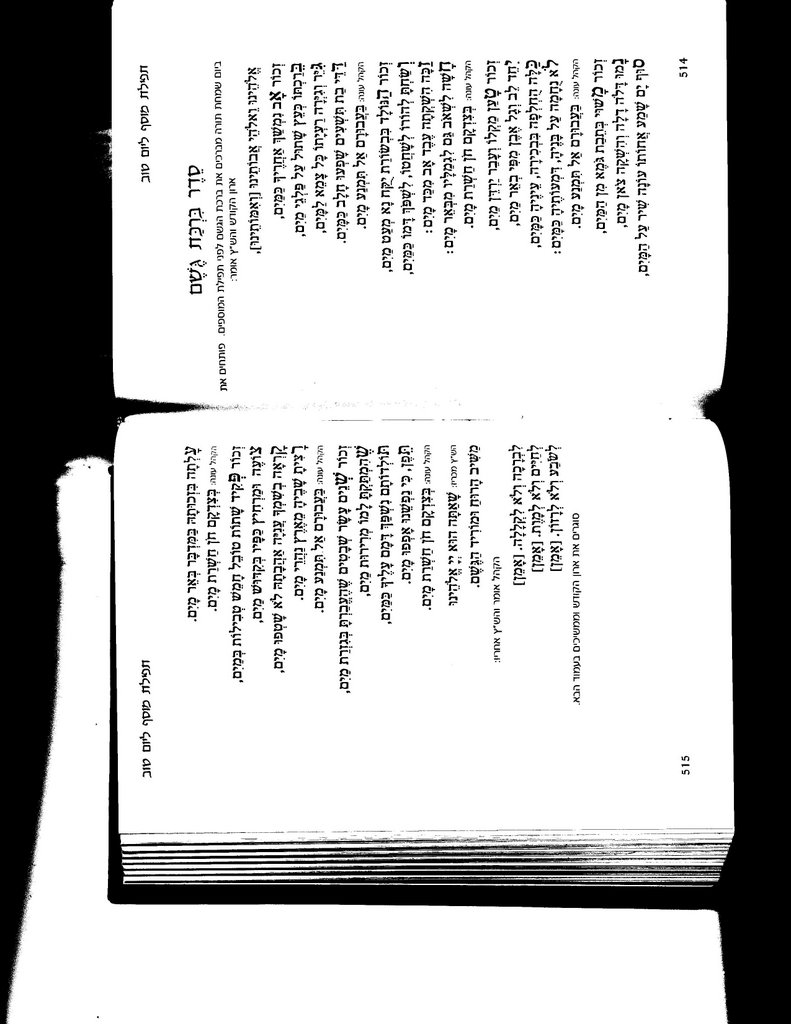
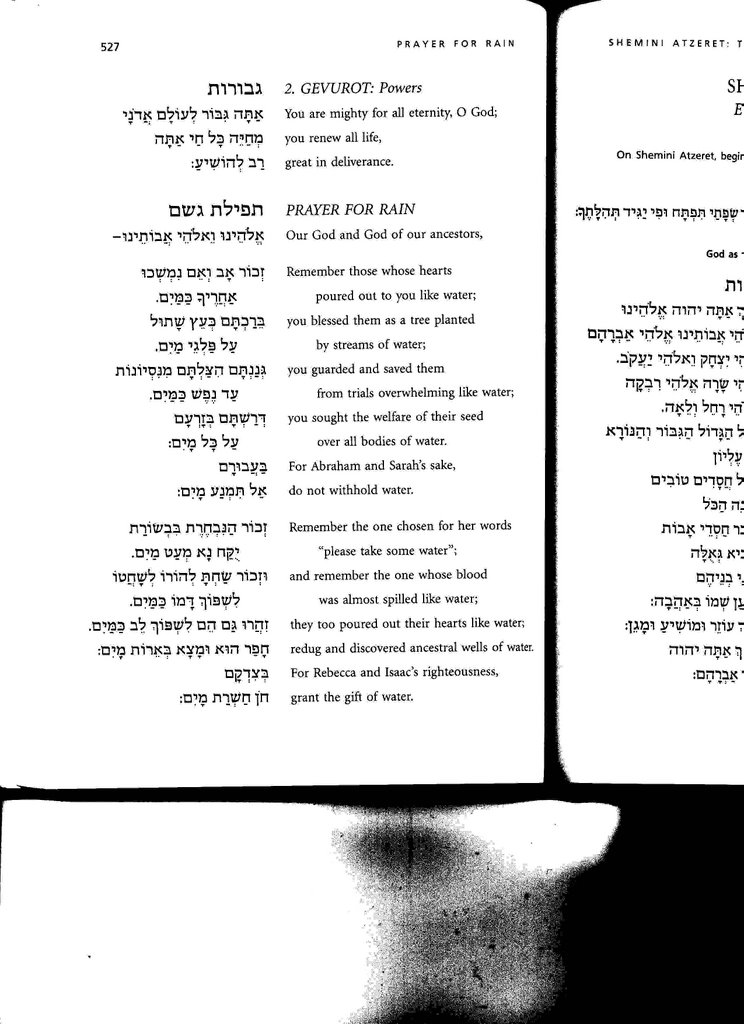
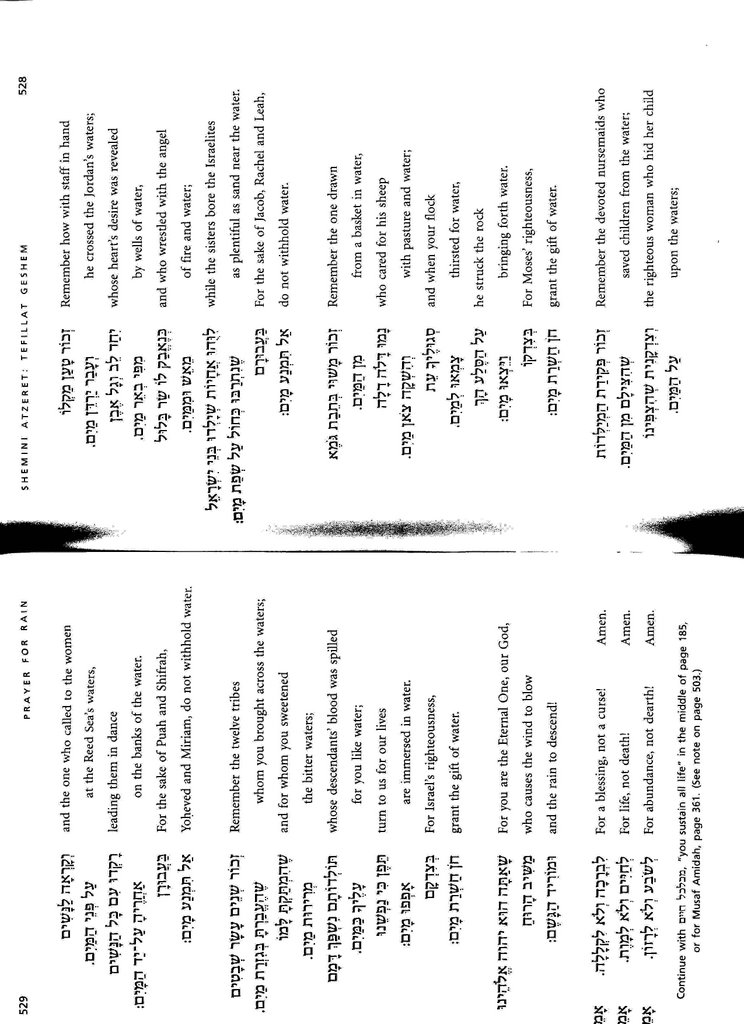
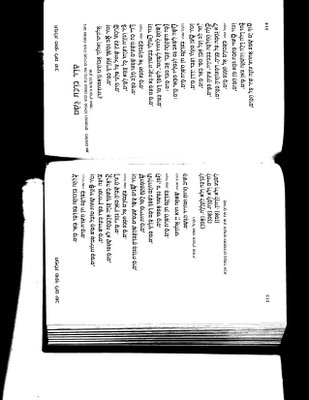
I've rediscovered the link to Zack's posting on this topic and don't want to lose track of it. I now have a copy of the Masorti siddur Va'ani Tefilati and its Geshem prayer including both female and male Biblical figures (written by Rabbi Gil Nativ) as well those from several other siddurim that do the same. (Please see images below for these versions!)

Be sure to check out the versions available online, linked to in Zack's original post:


Happy Sukkot (and/or Ramadan, full harvest moon, belated Feast of Saint Francis, etc.) to all!

Edit:

okay, this is a very not-clever way of doing things, but here's a JPEG of the text by Rabbi Dr. Gil Nativ, from the aforementioned Israeli Masorti siddur Va'ani Tefilati. Apologies for the bad orientation: I'm still not sure how to do much with things I scan, etc. -- but at least this way you can save it on your computer, manipulate it to face the correct way, etc. [RB note: I now have an English translation for this Hebrew--which has now been officially accepted for use in my minyan; please see the end of this post!*]

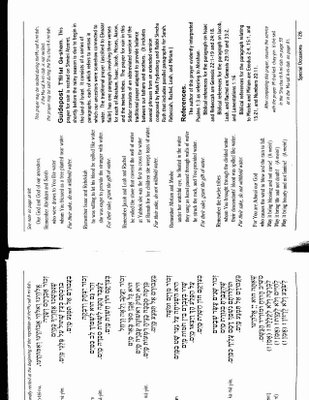
...and here's a JPEG of the version from Siddur Eit Ratzon (it cuts off the transliteration column, but it's got the complete Hebrew text & English translation; you can contact me if you want a PDF or JPEG of the cut-off page area; it says that it is based on the text by Mark Frydenberg):

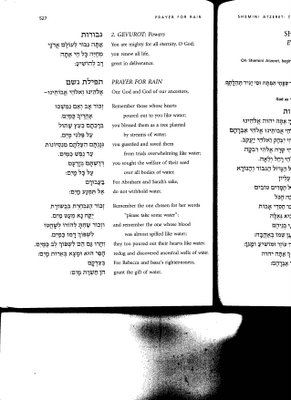
and finally, the version from the attractively-laid out interlinear Siddur Hadesh Yameinu (from Congregation Dorshei Emet, the Reconstructionist Synagogue of Montreal; I do not know the attribution for its newly-composed elements & would welcome more information to give cresit where it is due!)):
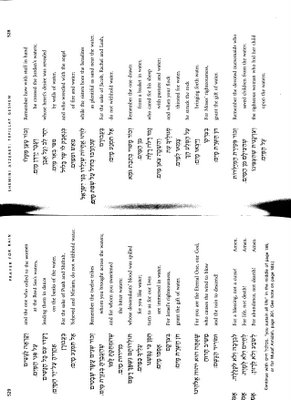

And here's an English composition I've just been made aware of:

A congregant of mine created her own English egalitarian additions to the tefilat Geshem. I forward them for those who might be interested, with her permission.
-- Josh Hammerman

TEFILLAT GESHEM – THE MISSING VERSES

By: Karen Hayworth Hainbach


REMEMBER SARAH

Lively, lovely eyes, clear as aqua water
Amid two harems, she stayed pure as water
She greeted passers-by with food and water
Her laughter bubbled as a spring of water

Congregation: For Sarah’s sake, send water!

REMEMBER RIVKA

She kindly sated man and beast with water
Guided by faith elemental as water,
She transposed twins, at odds as oil and water,
Switching Isaac’s blessing, precious as water

Congregation: For Rivka’s sake, bless us with water!

REMEMBER LEAH

Spurned, soft eyes burned by tears like salty water,
Sustained by faith deep as a well of water,
Fertile as a field, surfeited with water,
She praised God, thanks overflowing like water

Congregation: For Leah’s sake, favor us with water!


REMEMBER RACHEL

She met her husband by a well of water
He yearned for her as sabras thirst for water
Her children exiled to Babylon’s water,
Her tears cascaded as a fall of water

Congregation: For Rachel’s sake, comfort us with water!


REMEMBER MIRYAM

Miryam the Prophet, named for bitter water,
Protected Moses’ basket in the water
Timbrel in hand, she danced beside the water
In her merit, you sent the well of water

Congregation: For Miryam’s sake, provide us with water!


REMEMBER THE DAUGHTERS OF ISRAEL
They shunned the Calf - their virtue shone like water;
Gave copper mirrors, reflective as water,
To fashion the Mishkan’s laver of water;
And monthly dunked in mikvas’ cleansing water

Congregation: For their sake, shower us with water!


November 2004

* Thanks for Rabbi Leonard Berkowitz for providing me with this translation:

Geshem Prayer

for Rain

From Masorti Siddur Va'ani Tefillati, 1998

additional verses by Rabbi Gil Nativ

Translation: Rabbi Robert Scheinberg

Our God and God of our ancestors:

a Remember our father (AV), whose heart poured out to You like water;

b You blessed (BERACHTO) him, as a tree planted near water;

g He and his beloved drew near (GIYER) all who were thirsty for water;

d At age ninety, from her breasts (DADIM) milk flowed like water;

For the sake of Abraham and Sarah, do not withhold water!

h Remember the one (HANOLAD) whose birth was foretold as the angels drank water;

v You instructed (VESACHTA)

his father to spill his blood like water;

z The meritorious one (ZAKAH) gave the father's servant to drink from a pitcher of water;

h She hurried (CHASHAH) to draw also for his camels from the well of water;

For the sake of Isaac and Rebekah, grant the gift of water!

t Remember the one who took (TA'AN) his staff and crossed the Jordan's water;

y He gathered his heart (YICHED) and rolled the stone from the well of water;

k A bride (KALAH) switched with her elder, whose eyes were like water;

l She was not (LO) comforted over her sons; her tears were like water;

For the sake of Jacob, Rachel, and Leah, do not withhold water!

n Remember the one drawn forth (MASUI) in a bulrush basket from the water;

n They said (NAMU), "He drew water and provided the sheep with water."

s On the Sea of Reeds (SUF), he heard his sister lead a song at the water;

a In the desert there arose (ALTAH) on her behalf a well of water.

For the sake of Moses and Miriam, grant the gift of water!

p Remember the one appointed (PAKID) over the Temple, who would immerse himself five

times in water;

t He went (TZO'EH) to cleanse his hands with the sanctification of water;

q The poor one called (KAR'AH) out Your name; her love for You could not be

extinguished by water;

r You accepted (RATZITA) her returnees from the land of rivers of water.

For the sake of Zion and her Temple, do not withhold water!

sh Remember the twelve (SHNEMASAR)

tribes of Israel, whom You brought through the

water;

sh You sweetened (SHEHIMTAKTA)

the brackish marsh for their sake into sweet water.

t For You their descendants' (TOLDOTAM) blood was spilled like water.

t Turn to us (TEFEN) for

our souls are engulfed like water!

For all of Israel's sake, grant the gift of water!

For you are Adonai our God

who causes the wind to blow and the rain to fall

For blessing and not for curse (Amen)

For life and not for death (Amen)

For abundance and not for scarcity (Amen)

06 October 2006

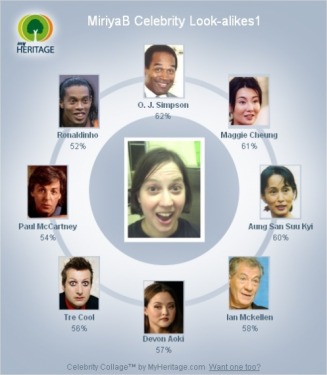
A Silly Photo Toy


See which celebrity you look like...

05 October 2006

Machzor Madness: In with the New!


I davened out for the first time out of Machzor Hadash/The New Machzor these Yamim Nora'im, at both the shul where I belong & the shul where I work--and I much prefer it to either the Harlow (which my previous Conservative kehillot have used, and which I led Rosh Hashanah/YK davening out of at Yale for several years) or the old Silverman (which the Traditional Minyan at Adas still uses, and which my childhood shul used lo those many moons ago).

It's got all of the advantages of the Harlow:
  • Conservative, not Orthodox, in its texts
  • not outrageouly voluminous and stuffed with piyyutim no one knows, but
  • keeps enough of the traditional texts and piyyutim people do know!
  • provides an alternative Yom Kippur mincha reading from Lev. 19 as well as the traditional reading of Lev. 18
and none of the disadvantages:
  • no evil purple text for Shabbat insertions (and is more attractively & legibly laid out in general)
  • actually translates on the left what's there in the Hebrew on the right, instead of abridging or fudging it (drove me crazy the way Harlow splits up the passages in Rosh Hashanah musaf amidah translation so you can't actually use it to see what you're davening when you know most but not all of the unfamiliar vocabulary), which allows you to actually use the 2 simultaneously or back-and-forth, unlike Harlow's set-up which presumes either complete Hebrew literacy or total ignorance of the Hebrew side of the page
  • has in the back an "alternative Amidah opening" which includes the matriarchs, and includes them all in its English translations of the Amidah (with a note saying that the translation is based on the alternative opening found on page 800-whatever)
  • has gender-sensitive language (I forget whether they claim to be gender-neutral, gender-balanced, or gender-sensitive...but I do know there's not a bunch of referring to God as He all over the place; I believe they pull the same trick as Slim Shalom re: phrases like "Adonai" or "Avinu Malkeinu," of transliterating them in italics in the English rather than either translating them with the gendered terms "Lord" and "Our father, our king" or with somewhat less accurate and less specific gender-neutral terms such as "Sovereign" and "Our parent, our ruler")
  • has good interpretive selections, separate from the translations (which, as I've said above, actually are translations of the Hebrew, instead of giving us a new English version of the Ashamnu that concludes "we are xenophobic, we yield to evil, we are zealots for bad causes"), and more of them as little short thought-provoking observations at the bottom of a page, thematically linked to the main traditional text appearing above it
  • has a martyrology that doesn't make me wince, but does make me cry--one that acknowledges that the history of Jewish suffering didn't just skip from Roman oppression to 19th/20th-c. Eastern Europe and Nazi Germany with nothing in between and nothing after (even if the rabbi leading Musaf in my service didn't use any of the 3 passages that had to do with medieval massacres and forced conversions, they were in there: one had to do with the Jews burned in the marketplace of Blois in the 12th century--a Jew from Sens drove me there at 11 at night, back in 1994, because I had wanted to visit the site) -- plus it acknowledges and includes Yiddish, the language spoken by most of the Jews who died in the Holocaust (prints the Yiddish text as well as the English translation of the Partisans' Song), instead of continuing to ignore the vernacular of the vast majority of Ashkenazi Jews from medieval times until the early-to-mid-20th century in favor of liturgical & modern Israeli Hebrew on the one hand and late-20th-c. English on the other
  • and that doesn't commit the transgression that I regard as politically charged and theologically near-blasphemous, of asking me to recite an Al Khet for "the sins which we have sinned before you and before them"--the six million--by evils such as appeasement or failure to act. We don't have intermediaries, saints, or intercessors in Judaism (by and large), and I'm not about to set up the victims of Nazi genocide, no matter how great their suffering or how important in our Jewish history, as some kind of semi-divine body before whom I should be genuflecting and confessing my sins, particularly ones of a semi-political nature.
  • has fewer hokey moments in the English translations or interpretive selections that would make me roll my eyes rather than raise them in reflection or gratitiude (I don't miss not having "who shall be torn by the wild beast of resentment, and who shall be drowned by the waters of jealousy"--I don't mind the idea, but never liked the execution, and I really do want to keep actual translation & interpretation separate)
Just about the only things lacking that one might complain of, so far as I can see, are:
  • The Avodah service does not include all of the descriptive text in the Hebrew (which we always skipped at Yale anyway: the rabbi read the narrative framing in English regardless): it provides the English for this narrative framing and then both Hebrew & English for everything the Kohen and the people said & the description of the recitation of the Name (which was what the hazzan would read/enact in Hebrew at Yale anyway). Fine by me! And if people really wanted more, it would be easy to make booklets/photocopies.
  • I don't remember seeing some of my old favorites from the English selections in the Harlow (poems by Anthony Hecht and maybe also A.M. Klein?)...but so much is gained in the other English readings they add that I can deal with this potential loss.
Until that new RA/USCJ machzor comes out, and unless it proves itself superior to what the Conservative rabbis & laypeople of Media Judaica have produced in Machzor Hadash/The New Machzor, I know what I'll be davening out of from now on on the High Holy Days. I thank Adas Israel and B'nai Israel for making it their machzor of choice, and I hope more kehillot (especially ones who haven't gotten around to replacing their Silvermans and are just now in the market for new machzorim) will follow their lead.

B'shalom,

Becca

[shamelessly repeated from my post to the Shefa Network
group ]

Oh, and P.S.:
Its prayer for the country & prayer for the state of Israel are both better IMHO than the ones in SimShalom & Harlow machzor. No more "administer all afFAIRs of state FAIRly" (my friend Shari's great point of amusement with the version of the Prayer for Our Country in Sim Shalom)!